
~20%
of student email gets opened
Announcements, deadline warnings, holds, the advisor's third attempt to reach them. The channel your outreach runs on is the channel students abandoned. Text is read at roughly 98%.
Paige is an AI success coach your students text. She answers at 11pm, nudges before the deadline closes, books the advising appointment into the system your advisors already use, and puts the students who went quiet on a short list for a human, weeks before census.
She never advises on withdrawal, mental health, conduct, or anything she is not certain about. Those stop the conversation and route to a named person on your staff, and Paige tells the student that is what she is doing.
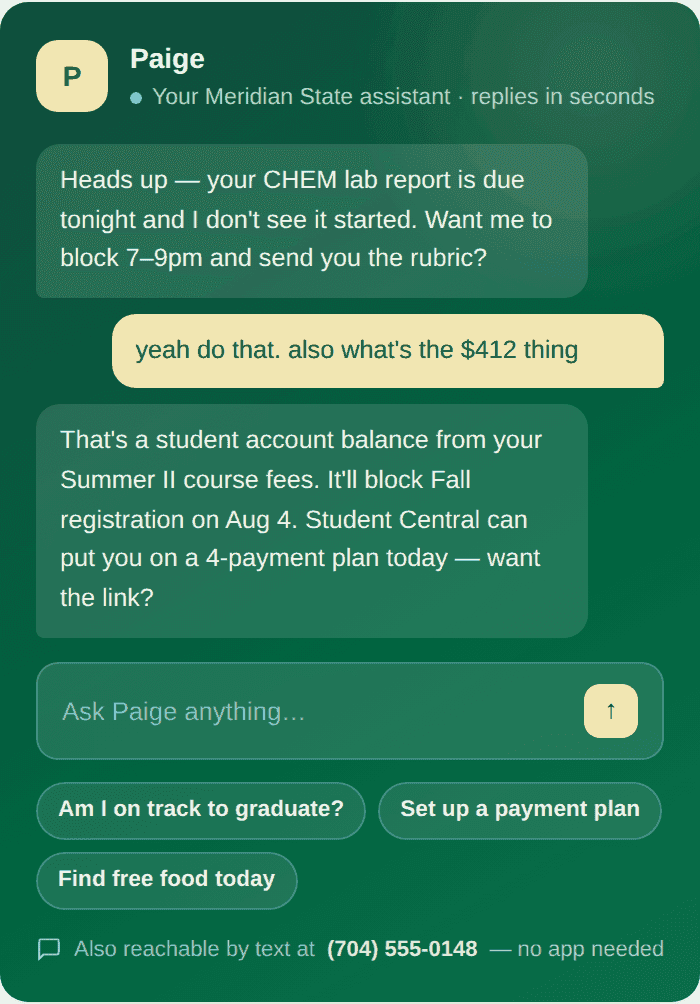
One thread. No portal, no login, no app, the same place they text their friends.
Every institution we talk to has the same four facts on the wall, and the same gap between them: the outreach exists, the caring staff exist, the early-alert data exists, and the student still goes quiet for six weeks without anyone noticing in time.
Announcements, deadline warnings, holds, the advisor's third attempt to reach them. The channel your outreach runs on is the channel students abandoned. Text is read at roughly 98%.
No one on your staff is failing. A caseload in the hundreds means the follow-up that would have mattered is the one there was no hour for.
Proactive advising campaigns land in the same inbox. The students who most need the outreach are the least likely to answer it, and silence reads exactly like everything is fine.
By the time a midterm report or an enrollment count surfaces the problem, the decision was made weeks earlier, usually in a quiet stretch nobody could see.
Sources: published SMS and email open-rate benchmarks; national advising caseload survey data; EAB coordinated-care campaign response rates. Figures are industry benchmarks, not measurements of your institution, we will run yours during the pilot.
One number. Students save it like a contact. She knows the academic calendar, the offices, the tutoring schedule, what is happening on campus this week, and, once a student verifies who they are, their own classes and progress. Every institution names and brands her: it is your program, not our logo.
Nothing new to log into. Nothing to remember the password for at 11pm on a Sunday.
Nothing to download, nothing to keep installed. Adoption is a student saving a number.
A chatbot waits to be asked. She reaches out first, before the deadline, not after the hold.
Where is tutoring tonight, why can't I register, who is my advisor, what do I need on the final, is anything happening this weekend. Answered from your calendars and your policies, with a citation to the source, never invented.
Registration opening, an advising hold, an aid document, a form that has to be in by Friday. Personal, timed, and capped, a contractual frequency limit, not a setting somebody could turn up.
She offers real availability, confirms the slot, writes it back to your advising platform, and reminds the student that morning. Your staff sees an appointment appear where they already look.
Two unanswered messages, a hold that never cleared, engagement dropping off. She works the caseload overnight and hands your advisor a short list in the morning, with what she already tried on every row.
Every dean asks the same first question, and it is the right question. So here is the answer before you have to ask: there are four conversations Paige stops rather than continues, and the stop is not a prompt asking her nicely. It is a gate in front of the model.
"Should I drop out?" ends the automated conversation. She holds the thread, says a person will reach out, and escalates to the named staff member on your escalation list.
A deterministic safety check runs before the model ever sees the message. Crisis signals get your campus counseling contact, the 988 line, and an immediate human escalation, 24/7, even when nudge quiet-hours are on.
She never promises confidentiality and never adjudicates. Scripted care, then routing to the office your institution configured. Your reporting posture is your setting, not our guess.
Every number, date, and status she states must trace back to a record or a cited policy page. If it does not, the answer is rewritten into a handoff. She is built to say "let me get you to someone who can check."
FERPA posture, the school-official designation, HECVAT, and an accessibility conformance report are in the trust package we send with the pilot agreement. Ask and we will send it before the demo.
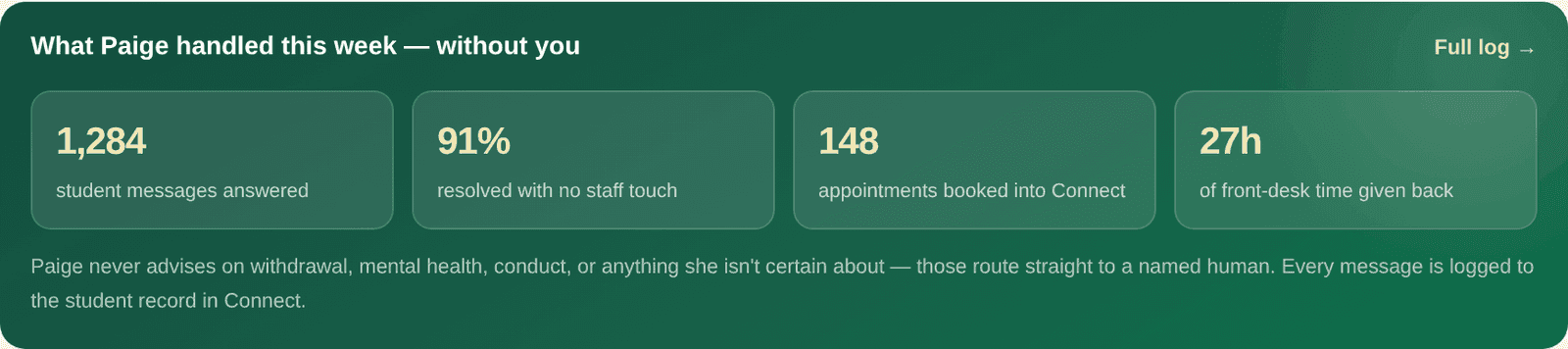
This is the artifact that decides it. Paige works the caseload overnight; your advisor opens a short list in the morning. Every row carries what she already tried, so nobody starts a conversation cold, and the row is on the list precisely because the next move needs a person.
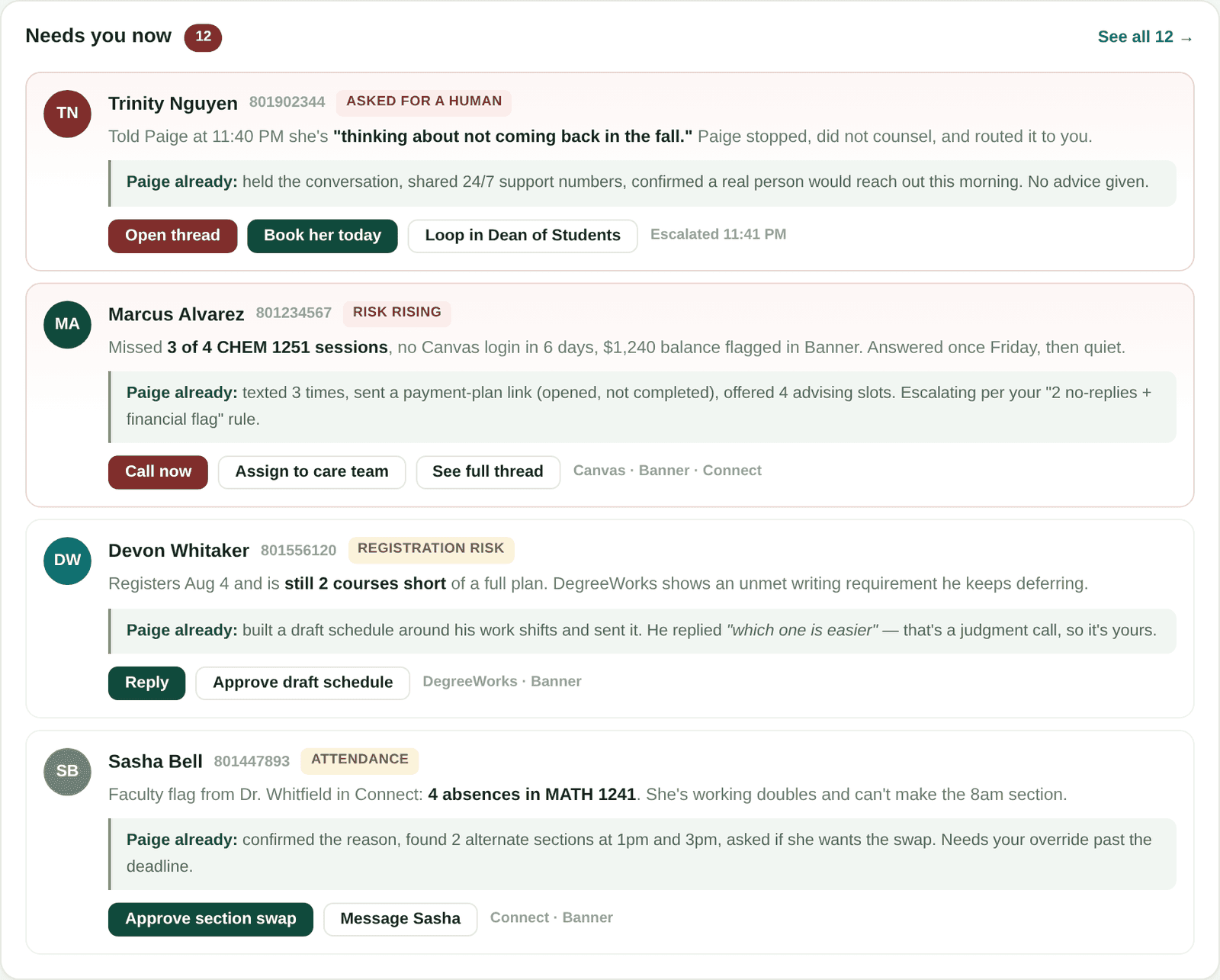
The top row is a student who told Paige at 11:40pm she was thinking about not coming back. Paige did not counsel her. She held the conversation, shared support numbers, promised a person in the morning, and escalated. Refusing is the behavior, not the failure.
Texted three times. Sent the payment-plan link. Offered four advising slots. Your advisor opens the row already three steps in, instead of starting at hello.
A student asked which course would be easier. Paige built the draft schedule, then handed the question over, because that one is an advisor's to answer, not hers.
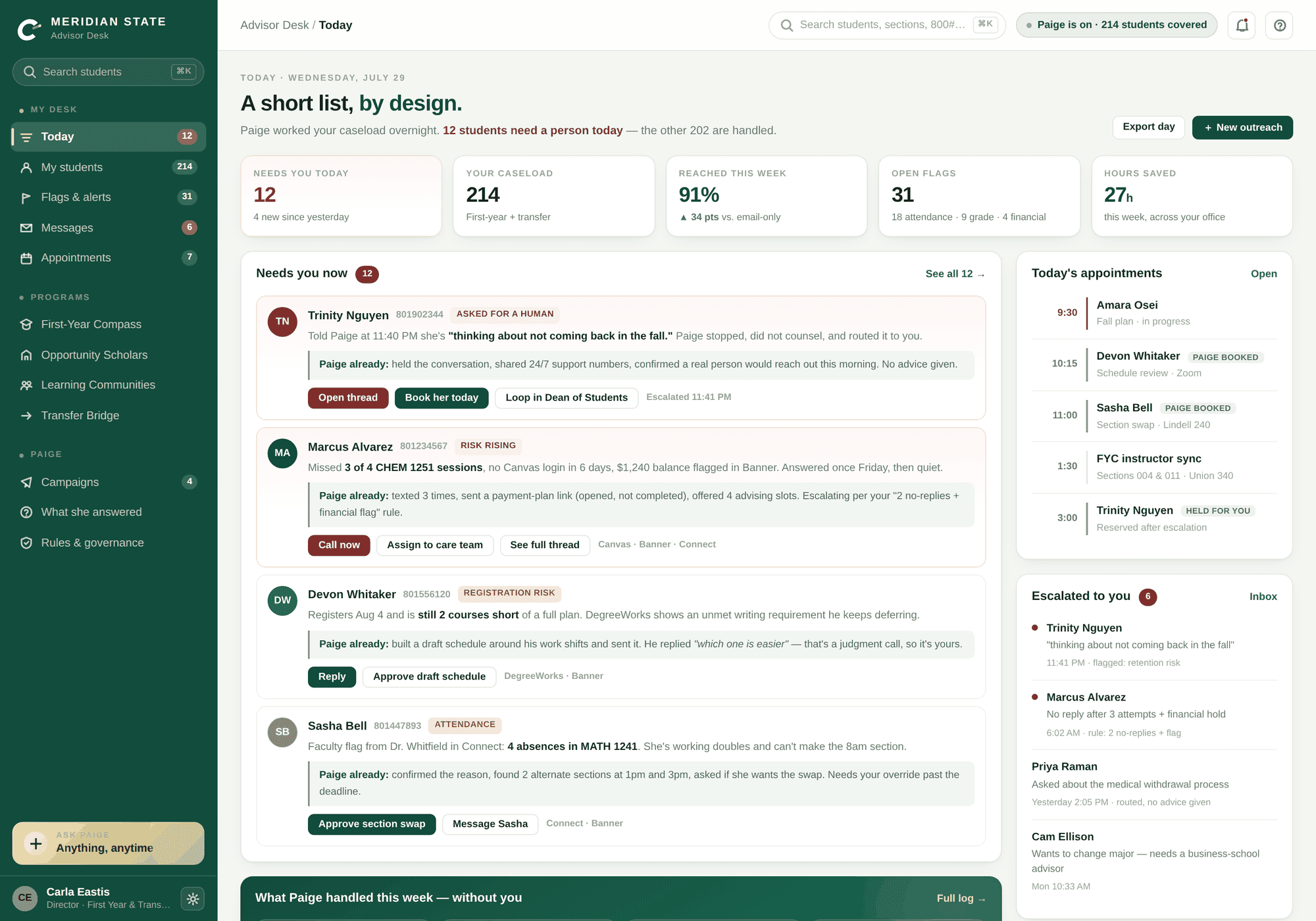
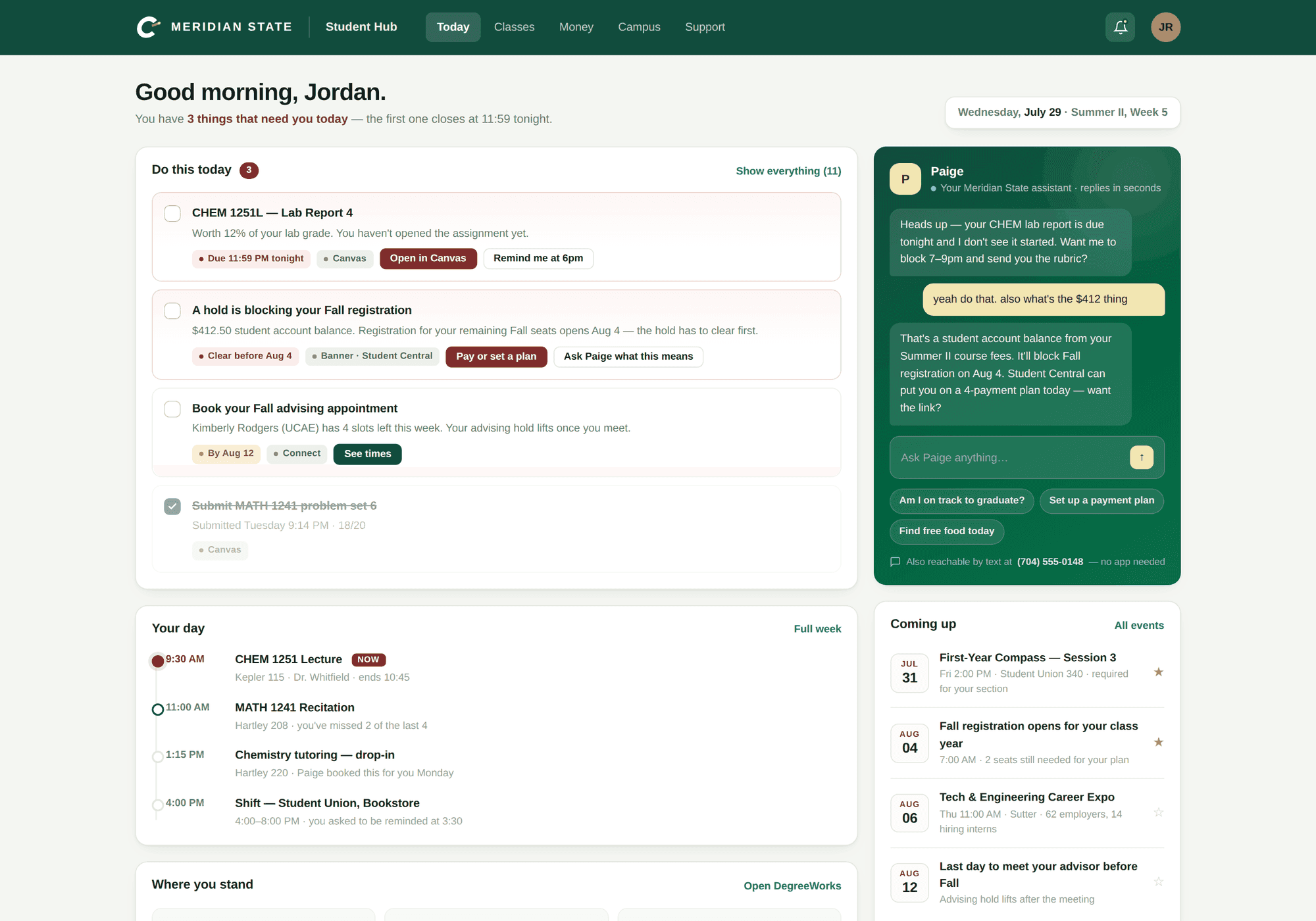
Your advisors keep Navigate, or Connect, or whatever your campaigns and case notes live in today. Nobody is asked to change where they work. Paige is the layer in front of it, the one that actually gets a reply - and everything she learns goes back into the platform your team already trusts.
Case notes, campaigns, appointment types, the early-alert workflow your team built. None of it moves. None of it is duplicated.
She runs the outreach in the one place students still answer, and holds the everyday thread, tutoring, events, deadlines, that makes the check-in that matters land.
Appointments she books appear on your advisors' calendars. Flags she raises appear on your dashboards. Conversations write back to the student record.
Your campus calendars, tutoring schedules, and athletics feeds are already public. Paige starts answering on those before a single student record is connected, so students have a reason to text her before the pilot agreement is even signed. Record access switches on only once the data agreement is stamped.
Pick a course, a first-year cohort, or one advising caseload. We stand Paige up for it in weeks. No RFP, no integration project, no invoice. You get the response rates, the escalation log, and the student feedback, then you decide what it is worth.
Would rather see the numbers first? See pricing.
I started in computer science at UNC Charlotte, switched to business management in the Belk College, and did not finish.
Nobody was tracking me. There was no moment where someone noticed I had gone quiet and reached out, the emails I was not opening were the system. I want to be careful here, because this is not a story about anyone failing me. My advisors had hundreds of students. The help was there. It was just on the other side of a channel I had stopped checking, and nobody had the hours to come find me on the one I actually used.
Pylor Ed is the thing that would have kept me enrolled. A number I would have texted back. Something that noticed the silence in week three instead of week eleven — and put me on somebody's short list while there was still a semester left to save.
I am the student you lost. This is what would have kept me.
- Sunny, founder, Pylor